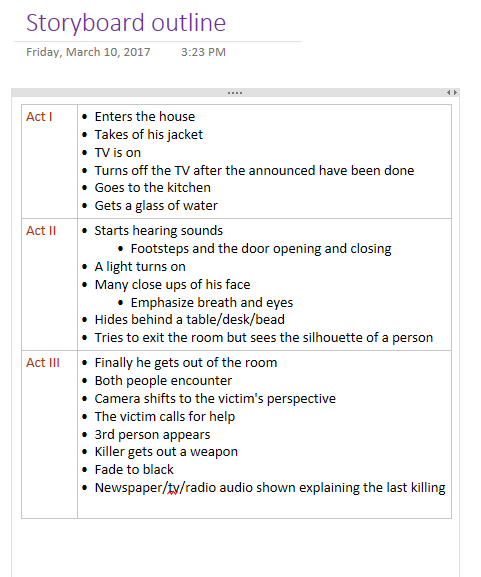
So as my Storyboard process starts, I made an outline of what I'm going to do for the scenes. I divided it into 3 Acts to established an introduction, a climax, and a conclusion to all the events.
I also occupied myself by doing a little more of research on the techniques most commonly used in my genre. Thanks to Mrs. Stoklosa, I came across this website which focuses on discussing Alfre Hitchcock's film techniques. This renowned director focuses on "Frame for Emotion". Jeffrey Michael Bays, author of the article, writes that "emotion comes directly from the actor's eyes'', which is the reason why I'm focusing so much on close-ups and extreme close-ups on the actor's faces. He also expresses that ''a sudden cut from wide to close-up will give the audience a sudden surprise''. I added this technique to my storyboard in one of the scenes when the killer starts hearing footsteps (you'll see it later when I post it).
Another point that Bays establishes is that the Point of View editing is key to ''build tension'' and prevent the audience of getting bored. This is actually an important technique to my production since the public will be experiencing everything from the killer's POV.
It's also important to keep the story as simple as possible since suspense will not be acquired if the production requires a lot of memorization. That's why my outline is basically the introduction to the main character, the creation of a problem/suspense, the resolution by killing the house owners.
Step 12 is the essence of my film. "Surprise and Twist''. Bays writes ''lead them [the audience] in one direction and then pull the rug out from under them in a surprise twist''. So once again, if performed well, the audience will think at the beginning that my killer is actually the homeowner when at the end it will be revealed that he is not.
Finally, I started my storyboard today and I finished all the scenes from Act I; hopefully, I will finish Act II and Act III this weekend.
Bays, Jeff. "Film Techniques of Alfred Hitchcock - suspense, camera angles, style, editing, basics." Film Techniques of Alfred Hitchcock - suspense, camera angles, style, editing, basics. N.p., n.d. Web. 16 Mar. 2017.
I think it's safe to say that everyone found it really helpful; there were some people in my group that needed advice on how to continue with their productions. Thankfully, I figured out the purpose of mine yesterday, so at least I had a base for what I wanted to share with my peers.
I discussed my plot with them and how I want to convey it and... they liked it! I was so excited because now I know that I;m not the only person who likes the story that I want to tell.
Even though I didn't need help with my plot as a whole, they did help me with the development of my film.They advised me to create a serial killer with a signature; so, after he commits his crime he would leave an object like a rose, a poker card, etc. In my case, it needs to be meaningful and correlated to the homosexual couples so the whole point of him being homophobic is understood by the audience in a smooth way.
Also, many of the movies that I watched present the killer(s) at the beginning of the movie by showing them attacking other people who are totally unrelated to the protagonists. For instance, in Ils a mom and a daughter crash into a tree and they have no signal on their phones to ask for help. So, the attackers take advantage of the situation and start making noises to scare them until they kill both of them.
Later on, the protagonist is seen driving by the same place where the family was attacked the previous night while their car is being towed by the police.
So basically what I wanted to was to show a fake newspaper or a fake news program showing a story of a killer who's been targeting homosexual couples so the crime is implicitly introduced beforehand. My group advised me to just add the audio from the news and I wouldn't have to go through all the work of filming a news program or making a fake newspaper.
I'm really excited and proud because at this point last year I still didn't have the minimum idea of what I wanted to do. But this year, everything is flowing so well and I'm really picturing the movie in my head.
I'll keep you updated with my storyboard process; wish me luck trying to draw all my scenes.
So basically, my previous post was all about exploring the different and diverse reasons why serial killer/psychopaths would invade a house. My goal was that by doing this, I would get inspiration for the reason that drives my character to intrude into a house. Nevertheless, this wasn't the outcome of the events.
After watching numerous movies, which by the way left me a little concerned about my safety inside my own home, I didn't find any solution for my initial problem. Therefore, I was frustrated and nervous that I wouldn't come up with an idea that would amaze me and others as well, in time for to start the whole production and post-production processes.
But... thank god to friends and after school events... I just come from attending ''Hair'' the musical performed by the Drama Class from my school. While I was there, I was relating my problem to my friend hoping that she would analyze it from a different perspective. So as we were thinking about a logical and interesting motive, she mentioned my characters selection and I said that I want my intruder to be a man and then the house owners could be a couple (I'll explain later why). Then I stated that the latter could be a lesbian couple to be less cliché and create a more modern representation. And, just like that, I created my plot:
It's going to be about this homophobic (serial) killer who enjoys killing homosexual couples.
You're Next(2011)
Basically, the whole concept of the different point of view is maintained, so the killer is introduced first as he enters the house, without the audience knowing that he's the intruder.
Now I can make my storyboard using my plot as the base so I can start the whole production activity next week.
As I was watching my whole movie selection, I was aware of the camera shots and angles that were used. The most typical techniques are the following:
- Close ups:
It's mostly used to show the victim(s) face, rather than the attackers'. Thriller movies are all about what the protagonist feels and reacts to certain situations, and this is the perfect way to show that. Thus, any anxious or frustrating event is a situation where a close-up should be utilized.
- Hand-held camera:
Especially used when there are chase sequences. This technique gives tension and realism to the film since it's shown from the protagonist's perspective and it let the viewer immerse him/herself into the movie's experience. The presence of hand-held is predominant in this scene from You're Next to show the fear and the uncertainty of all the characters as arrows fly to their dining room.
- Point of view shot:
By changing the camera to what the character is seeing, the audience is introduced to the time and space of the shown events and so it puts the audience into the ''protagonist's shoes''. I think this is going to be a predominant shot in my film since my purpose is to introduce my audience to the POV of the antagonist, even if they don't know that he's the antagonist. This shot might be linked to over-the-shoulder shots to support the character's POV from different types of shots.
- Low-key lighting
This is a fundamental technique in this genre. Mainly, it adds mystery to the scene since the camera is showing what the character is seeing, which is basically nothing. By reducing the characters' sightedness, the antagonist adds more power and he's able to surprise his victim more easily. Therefore, this creates more tension in the viewer and he/she gets scared as well.
Other predominant techniques are the presence of fast editing, showing numerous shots and maintaining the viewer on his/her feet as the scene develops, and sound effects and music. Everyone remembers the specific score from Jaws every time the shark would come nearby to one of his victims or the memorable violins from Psycho. Even The Shining is remembered by its instrumental sound as Jack chases his wife and kid. This type of sound add more suspense to the movie and warn the viewer that danger is close.
This scene from The Strangers shows both the use of hand-held camera and sound effects rather than dialogue. The camera follows Kristen journey as she runs through the house trying to escape from the killers while immersing the viewer in the anxious experience. All the knocks on the walls/door, as well as the vinyl music, play psychologically with the character, creating tension and suspense in the scene.
Now that I have a list of the most important techniques that I should introduce in my film, I can start my storyboarding process, which hopefully I'll have done by mid-next week.
Let's start by stating the reasons why I'm so focused on doing something related to home invasion. I think it all started when I watched When a Stranger Calls (2006). I believe I was like 14 or 15 and I felt so connected with the protagonist. We both are brunettes and even though she was a little older than I, I was currently having a job as a babysitter as well. I think what impacted me more from the movie was that the house had an alarm system but the psychopath entered anyways. After that, it was all about the uncertainty and the anxiety that I had throughout the film due to the origin of the unknown calls.
So since then, I've been scared of someone entering my house more than I'm scared of paranormal activities. You never know if a remote sound at night is a killer entering your house or if it's just the pipes, or if the floor is creaking because of your cat or because and unsub is walking to your bedroom with killing intentions. It's just the terror that you're not safe even inside your house, you're exposed to any danger 24/7. *the following content is full of spoilers*
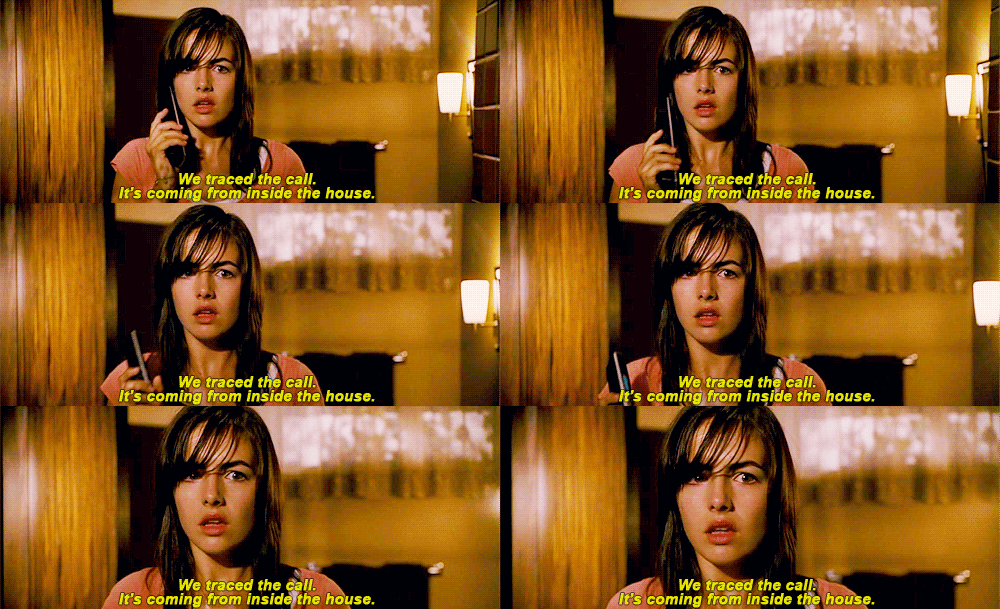
As I previously stated, this film by Simon West, was one of the first horror films that I watched. Jill Johnson (Camilla Belle) is babysitting two kids for the night when she starts getting phone calls from a stranger. Jill manages to keep the unsub in the line for more than 60 seconds so the police can track his number, and then it's revealed that the stranger is inside the house. Basically, the rest of the film is about Jill trying to protect the kids and the intruder trying to kill her before the police get there.
Throughout the interaction of Jill and the Stranger, there's no releasement of his reasons other than he enjoys his psychological game with Jill.
The Strangers (2008)
Even though it's stated in the opening that this film by Bryan Bertino is based on true events, the movie is extremely modified to enter the thriller genre and add more suspense to the movie, thus impacting of the viewer's anxiety and fear as he/she watches it. (You can read more about the events that ''inspired'' this movie here).
Basically, the story goes about a troubled couple which, unfortunately, has to spend the night together. However,
their quietness is interrupted by 3 masked people who decide to terrorize them and kill them at the end. The most shocking aspect about this narration is the reason why the attackers decided to invade the house. As Kristen ask her aggressors "Why are you doing this to us?" one of them answers: "Because you were home''. There's no other logical explanation to this response other than to state that these people were psychopaths who enjoyed the psychological torture of their victims.
Ils (2006)
This french movie, which title translates to ''Them", has been praised a lot among the top home invasion movies rating. Once again the beginning of this film states that the events presented are true, which in reality is fake.
This movie continues the cliché of a couple staying in an isolated house, surrounded only by a large extension of trees. Everything is peaceful and tranquil when suddenly the couple starts hearing noises outside and inside the house, followed by power cuts and other predictable acts to intimidate them. Throughout the film, the numb
er of attackers is never revealed nor their specific bodies/faces, leaving everything to the viewer's imagination. Nevertheless, this movie is closer to reality than the previous one since it's supposed to be based on a French couple who spent their weekend in a remote house in the Chezch Republic where they were attacked by 3 teenagers.
However, it's still hard to believe that these events happened as presented since no one survived to relate them. But if we follow the director's explanation, the perpetrators of the killings were children between 10 and 15 years old who appear to have a secret life in the sewers. The ending graphics state that the children only wanted to play with their victims, giving the illusion that they killed them because the attacked didn't want to play. Once again, psychopath symptoms appear.
Kidnapped (2010)
To continue with the European film wage, this Spanish film directed by Miguel Ángel Vivas exposes a pretty usual and ordinary home invasion. Jaime, Marta, and Isabella are a family who just moved to a luxurious and spacious house. One of the guys from the moving agency begrudges their wealthy status and decides to pay them a little visit at night with 2 of his co-workers. What started as a simple robbery ends up being a massacre when things go south due to different unpredictable events.
I refer to this situation as usual since, compared to the previously presented movies, the attackers didn't plan their night motivated by the entertainment of this family torture. This plot it's just about the wide gap between the rich and the poor in some European countries.
Hush (2016)
I finish this list with my favorite film among all the previously stated. Mike Flanagan does an excellent job presenting the home invasion/kill attempt situation for a deaf person. In the beginning, cooking sounds are emphasized and later deleted to understand Maddie's condition. Towards the end of the production, sounds are deleted again and movements slow down to follow Maddie's thought process and underline her other senses.
The film simply stands out from the rest due to the protagonist conditions, since basically, it follows the same storyline as the rest: isolated house in the woods and a psychopath killer who enjoys what he does.
Basically, most of thriller/horror films are based on the psychopath storyline, even though some might stand out due to economic necessities. Now it's my time to decide what storyline I'm going to choose for my short film.
Resources:
"When a Stranger Calls (2006 film)." Wikipedia. Wikimedia Foundation, 06 Mar. 2017. Web. 07 Mar. 2017.
"The Strangers (2008 film)." Wikipedia. Wikimedia Foundation, 06 Mar. 2017. Web. 07 Mar. 2017.
"Them (2006 film)." Wikipedia. Wikimedia Foundation, 06 Mar. 2017. Web. 07 Mar. 2017.
I talked to my teacher yesterday about my idea for my short film, but she said it was too cliché and so I should think about something more original.
I was really stressed after that because I thought that I wouldn't come up with an amazing plot and I didn't want to spend ample time thinking about it, just like I did last year (huge mistake). However, I did my best to think about a simple story that would be both original and interesting for the viewer and for myself.
By the end of the day, I had 3 ideas:
Interrogation room: Basically start with 2 characters, one is being questioned by the other about something that he/she did, but the viewer doesn't know what. This would stay like this until the end of the film, when the action is finally revealed.
Chaser/stalker: A girl becomes aware that she's being chased by a guy. Nevertheless, she ends up getting kidnapped by another guy that she didn't see and the first one helps her. This could also be that a girl was being chased by a guy but at the end is the girl who's the killer.
The Strangers (2008)
Change of perspectives: Film the same break in story but from the perspective of the intruder but without explicitly saying that he's the intruder. Basically, the camera would allude that the intruder is the house's owner but at the end, the viewer discovers that this isn't true.
From these 3 options, I like most the latter. Personally, I think that it's innovative and I haven't seen it before in another film. So I talked to my teacher today and she liked it but she advised me that I should think about the intruder's purpose.
Why is he breaking into the house? Why is he killing the other person?
These are the questions that I intend to answer over the weekend and have a clear reason by Monday so I can start my storyboard next week. We're moving fast!
I know that I stated in my last post that I was going to write in the next couple of days but it have been some crazy weeks and I haven't had time to do my proper research. However, I did watch a couple of movies that relate to what I want to do.
Since last year, I've wanted to make a thriller/horror film; the problem was that back then I didn't have a clear idea of something that I'd wanted to do. But this year it's different; I'm decided to do a thriller short film which is going to be related to mental illnesses, specifically Schizophrenia. I really don't know why I decided to do my soon-to-be short film about this topic; maybe it's because I watched Shutter Island (2010) over the summer, or I just thought that I'd be cool to make a something about a topic that represents a taboo in the media.
Now, let's start with my research. Basically, this condition affects a person's ability to feel, think, and behave clearly. "The exact cause of schizophrenia isn't known, but a combination of genetics, environment and altered brain chemistry" may contribute to its development
"Schizophrenia is characterized by thoughts or experiences that seem out of touch with reality, disorganized speech or behavior, and decreased participation in daily activities. A difficulty with memory may also be present."
Ages affected by Schizophrenia
What I'm interested in for my film, are the positive symptoms of this disease, which include:
Hallucinations: seeing, feeling, tasting, hearing or smelling something that doesn’t really exist. The most common experience is hearing imaginary voices that give commands or comments to the individual.
Delusions: false ideas--individuals may believe that someone is spying on him or her, or that they are someone famous (or a religious figure).
Thought disorders (unusual or dysfunctional ways of thinking)
Movement disorders (agitated body movements)
The negative and cognitive symptoms are more severe and are associated with disruptions to normal emotions and behaviors, and this is not the round that I'm striving for my character.
Basically, the main 2 positive symptoms, hallucinations and delusions, are linked to psychosis. Psychosis is often described as a “loss of reality” or a “break from reality” because it makes the person experience or believe things that aren’t real. It can change the way someone thinks, acts, feels or senses things.
The big question about this condition is:
Can a schizophrenic person lead a regular life?
"In one study published in 2005 psychologist Martin Harrow of the University of Illinois College of Medicine and his colleagues followed patients over 15 years and found that about 40 percent experienced at least periods of considerable recovery, as measured by the absence of significant symptoms as well as the capacity to work, engage in social activities and live outside a hospital for a year or more. Although mild symptoms such as social withdrawal or confused thinking may persist, these individuals can hold down jobs and function independently without being institutionalized."
So, now that I have a clear idea of what this condition entails, I can start developing my main character. I'll be back with some case studies in the next couple of days!
Resources:
Lilienfeld, Scott O., and Hal Arkowitz. "Living with Schizophrenia." Scientific American. N.p., 06 Feb. 2010. Web. 01 Mar. 2017.
"Schizophrenia." Mental Health America. N.p., 08 Dec. 2016. Web. 01 Mar. 2017.
National Institutes of Health. U.S. Department of Health and Human Services, n.d. Web. 01 Mar. 2017.